E&I Engineers and Technician
We Love to work on E&I field. We also like to teach our friends who need to improve their knowledge
Saturday, July 4, 2026
Pressure Sensors
Friday, February 14, 2025
Strain guage
Strain guages
Strain gauges consist of a metal foil strip, flat length of metal wire, or a strip of semiconductor material which can be stuck onto surfaces like a postage stamp. When the wire, foil, strip, or semiconductor is stretched, its resistance R changes. The fractional change in resistance ΔR/R is proportional to the strain ε, i.e.: Δ R/R =G
where G, the constant of proportionality, is termed the gauge factor. Metal strain gauges typically have gauge factors of the order of 2.0. When such a strain gauge is stretched its resistance increases, and when compressed its resistance decreases. Strain is ‘change in length/original length’ and so the resistance change of a strain gauge is a measurement of the change in length of the gauge and hence the surface to which the strain gauge is attached. Thus a displacement sensor might be constructed by attaching strain gauges to a cantilever, the free end of the cantilever being moved as a result of the linear displacement being monitored. When the cantilever is bent, the electrical resistance strain gauges mounted on the element are strained and so give a resistance change which can be monitored and which is a measure of the displacement.
Range 0 to 100 mm
Non-linearity error 60.1% of full range
Temperature sensitivity 60.01% of full range/°C
A problem that has to be overcome with strain gauges is that the resistance of the gauge changes when the temperature changes and so methods have to be used to compensate for such changes in order that the effects of temperature can be eliminated.
General Purpose Precision strain gauges
General purpose precision strain gauges are encapsulated constantan foil strain gauges offered in a wide variety of patterns for scientific, industrial and experimental stress analysis. These precision strain gauges can be used for experimental stress analysis monitoring industrial equipment or various scientific applications. In the General purpose strain gauge section you will find the strain gauge patterns next to the part numbers so that you will be able to see the geometry of the strain gauge. The gauge dimensions are also provided in and SI (Metric, mm) and US Customary (English, inches) units. General purpose precision strain gauges are offered in linear patterns, dual parallel- grid patterns, Tee rosettes (0/90°), rectangular or delta (45° or 60°), stacked or planar rosettes, and shear patterns.
Transducer Quality strain gauges
Transducer-quality strain gauges are for customers who are manufacturing transducers or similar sensing devices. Transducer-quality strain gauges feature a tighter tolerance on the carrier trim dimensions which allows the carrier edge to be used for strain gauge alignment if required. They also feature tighter tolerances on nominal resistance values. These gauges can be creep adjusted to meet a transducer manufacturer’s specifications and they can be customized to the unique requirements of a transducer. They are also excellent gauges off-the- shelf for experimental stress analysis and/or strain verification projects.
STRAIN GAUGE SELECTION CONSIDERATIONS
- Gauges Length
- Number of Gauges in Gauge Pattern
- Arrangement of Gauges in Gauge Pattern
- Grid Resistance
- Strain-Sensitive Alloy
- Carrier Material
- Gauge Width
- Solder Tab Type
- Configuration of Solder Tab
- Availability
Sunday, May 10, 2020
PLC
What is a PLC?
A PROGRAMMABLE LOGIC CONTROLLER (PLC) is an industrial computer control system that continuously monitors the state of input devices and makes decisions based upon a custom program to control the state of output devices.
Almost any production line, machine function, or process can be greatly enhanced using this type of control system. However, the biggest benefit in using a PLC is the ability to change and replicate the operation or process while collecting and communicating vital information.
Another advantage of a PLC system is that it is modular. That is, you can mix and match the types of Input and Output devices to best suit your application.
HISTORY OF PLCS
The first Programmable Logic Controllers were designed and developed by Modicon as a relay re-placer for GM and Landis.
- These controllers eliminated the need for rewiring and adding additional hardware for each new configuration of logic.
- The new system drastically increased the functionality of the controls while reducing the cabinet space that housed the logic.
- The first PLC, model 084, was invented by Dick Morley in 1969
- The first commercial successful PLC, the 184, was introduced in 1973 and was designed by Michael Greenberg.
WHAT IS INSIDE A PLC?
The Central Processing Unit, the CPU, contains an internal program that tells the PLC how to perform the following functions:
- Execute the Control Instructions contained in the User's Programs. This program is stored in "nonvolatile" memory, meaning that the program will not be lost if power is removed
- Communicate with other devices, which can include I/O Devices, Programming Devices, Networks, and even other PLCs.
- Perform Housekeeping activities such as Communications, Internal Diagnostics, etc.
HOW DOES A PLC OPERATE?
There are four basic steps in the operation of all PLCs; Input Scan, Program Scan, Output Scan, and Housekeeping. These steps continually take place in a repeating loop.
Four Steps In The PLC Operations
|
|
WHAT PROGRAMMING LANGUAGE IS USED TO PROGRAM A PLC?
While Ladder Logic is the most commonly used PLC programming language, it is not the only one. The following table lists of some of languages that are used to program a PLC.
Ladder Diagram (LD) Traditional ladder logic is graphical programming language. Initially programmed with simple contacts that simulated the opening and closing of relays, Ladder Logic programming has been expanded to include such functions as counters, timers, shift registers, and math operations.
Function Block Diagram (FBD) - A graphical language for depicting signal and data flows through re-usable function blocks. FBD is very useful for expressing the interconnection of control system algorithms and logic.
Structured Text (ST) – A high level text language that encourages structured programming. It has a language structure (syntax) that strongly resembles PASCAL and supports a wide range of standard functions and operators. For example;
| If Speed1 > 100.0 then Flow_Rate: = 50.0 + Offset_A1; Else Flow_Rate: = 100.0; Steam: = ON End_If; |
Instruction List (IL): A low level “assembler like” language that is based on similar instructions list languages found in a wide range of today’s PLCs.
LD MPC LD ST RESET: ST | R1 RESET PRESS_1 MAX_PRESS LD 0 A_X43 |
Sequential Function Chart (SFC) A method of programming complex control systems at a more highly structured level. A SFC program is an overview of the control system, in which the basic building blocks are entire program files. Each program file is created using one of the other types of programming languages. The SFC approach coordinates large, complicated programming tasks into smaller, more manageable tasks.
WHAT ARE INPUT/OUTPUT DEVICES?
INPUTS | OUTPUTS | ||||||||||
|
| ||||||||||
|
| ||||||||||
WHAT DO I NEED TO CONSIDER WHEN CHOOSING A PLC?
There are many PLC systems on the market today. Other than cost, you must consider the following when deciding which one will best suit the needs of your application.
- Will the system be powered by AC or DC voltage?
- Does the PLC have enough memory to run my user program?
- Does the system run fast enough to meet my application’s requirements?
- What type of software is used to program the PLC?
- Will the PLC be able to manage the number of inputs and outputs that my application requires?
- If required by your application, can the PLC handle analog inputs and outputs, or maybe a combination of both analog and discrete inputs and outputs?
- How am I going to communicate with my PLC?
- Do I need network connectivity and can it be added to my PLC?
- Will the system be located in one place or spread out over a large area?
PLC ACRONYMS
The following table shows a list of commonly used Acronyms that you see when researching or using your PLC.
| ASCII | American Standard Code for Information Interchange |
| BCD | Binary Coded Decimal |
| CSA | Canadian Standards Association |
| DIO | Distributed I/O |
| EIA | Electronic Industries Association |
| EMI | ElectroMagnetic Interference |
| HMI | Human Machine Interface |
| IEC | International Electrotechnical Commission |
| IEEE | Institute of Electrical and Electronic Engineers |
| I/O | Input(s) and/or Output(s) |
| ISO | International Standards Organization |
| LL | Ladder Logic |
| LSB | Least Significant Bit |
| MMI | Man Machine Interface |
| MODICON | Modular Digital Controller |
| MSB | Most Significant Bit |
| PID | Proportional Integral Derivative (feedback control) |
| RF | Radio Frequency |
| RIO | Remote I/O |
| RTU | Remote Terminal Unit |
| SCADA | Supervisory Control And Data Acquisition |
| TCP/IP | Transmission Control Protocol / Internet Protocol |
Thursday, August 9, 2018
Flow meters
Flow Meters
Introduction to Flow Measurement
One of the most common flow measurement mistakes is the reversal of this sequence: instead of selecting a sensor which will perform properly, an attempt is made to justify the use of a device because it is less expensive. Those "inexpensive" purchases can be the most costly installations. This page will help you better understand flow meters, but you can also speak to our application engineers at anytime if you have any special flow measurement challenges.

Learn more about flow meters
Flow Measurement Orientation
The basis of good flow meter selection is a clear understanding of the requirements of the particular application. Therefore, time should be invested in fully evaluating the nature of the process fluid and of the overall installation.First Steps to Choose the Right Flow Meter
The first step in flow sensor selection is to determine if the flowrate information should be continuous or totalized, and whether this information is needed locally or remotely. If remotely, should the transmission be analog, digital, or shared? And, if shared, what is the required (minimum) data-update frequency? Once these questions are answered, an evaluation of the properties and flow characteristics of the process fluid, and of the piping that will accommodate the flow meter, should take place. In order to approach this task in a systematic manner, forms have been developed, requiring that the following types of data be filled in for each application: Download the Flow Meter Evaluation Form.
Fluid and flow characteristics
The fluid and its given and its pressure, temperature, allowable pressure drop, density (or specific gravity), conductivity, viscosity (Newtonian or not?) and vapor pressure at maximum operating temperature are listed, together with an indication of how these properties might vary or interact. In addition, all safety or toxicity information should be provided, together with detailed data on the fluid's composition, presence of bubbles, solids (abrasive or soft, size of particles, fibers), tendency to coat, and light transmission qualities (opaque, translucent or transparent?).Pressure & Temperature Ranges
Expected minimum and maximum pressure and temperature values should be given in addition to the normal operating values when selecting flow meters. Whether flow can reverse, whether it does not always fill the pipe, whether slug flow can develop (air-solids-liquid), whether aeration or pulsation is likely, whether sudden temperature changes can occur, or whether special precautions are needed during cleaning and maintenance, these facts, too, should be stated.Piping and Installation Area
Concerning the piping and the area where the flow meters are to be located, consider: For the piping, its direction (avoid downward flow in liquid applications), size, material, schedule, flange-pressure rating, accessibility, up or downstream turns, valves, regulators, and available straight-pipe run lengths. The specifying engineer must know if vibration or magnetic fields are present or possible in the area, if electric or pneumatic power is available, if the area is classified for explosion hazards, or if there are other special requirements such as compliance with sanitary or clean-in-place (CIP) regulations.KEY QUESTIONS TO ASK WHEN CHOOSING A FLOW METER
1. What is the fluid being measured?
2. Do you require rate measurement and/or totalization?
3. If the liquid is not water, what viscosity is the liquid?
4. Do you require a local display on the flow meter or do you need an electronic signal output?
5. What is the minimum and maximum flowrate?
6. What is the minimum and maximum process pressure?
7. What is the minimum and maximum process temperature?
8. Is the fluid chemically compatible with the flow meter wetted parts?
9. If this is a process application, what is the size of the pipe??
Flow rates and Accuracy
The next step is to determine the required meter range by identifying minimum and maximum flows (mass or volumetric) that will be measured. After that, the required flow measurement accuracy is determined. Typically accuracy is specified in percentage of actual reading (AR), in percentage of calibrated span (CS), or in percentage of full scale (FS) units. The accuracy requirements should be separately stated at minimum, normal, and maximum flowrates. Unless you know these requirements, your flow meter's performance may not be acceptable over its full range.In applications where products are sold or purchased on the basis of a meter reading, absolute accuracy is critical. In other applications, repeatability may be more important than absolute accuracy. Therefore, it is advisable to establish separately the accuracy and repeatability requirements of each application and to state both in the specifications.
When a flow meter's accuracy is stated in % CS or % FS units, its absolute error will rise as the measured flow rate drops. If meter error is stated in % AR, the error in absolute terms stays the same at high or low flows. Because full scale (FS) is always a larger quantity than the calibrated span (CS), a sensor with a % FS performance will always have a larger error than one with the same % CS specification. Therefore, in order to compare all bids fairly, it is advisable to convert all quoted error statements into the same % AR units.
In well-prepared flow meter specifications, all accuracy statements are converted into uniform % AR units and these % AR requirements are specified separately for minimum, normal, and maximum flows. All flow meters specifications and bids should clearly state both the accuracy and the repeatability of the meter at minimum, normal, and maximum flows.
Accuracy vs. Repeatability
If acceptable metering performance can be obtained from two different flow meter categories and one has no moving parts, select the one without moving parts. Moving parts are a potential source of problems, not only for the obvious reasons of wear, lubrication, and sensitivity to coating, but also because moving parts require clearance spaces that sometimes introduce "slippage" into the flow being measured. Even with well maintained and calibrated meters, this unmeasured flow varies with changes in fluid viscosity and temperature. Changes in temperature also change the internal dimensions of the meter and require compensation.Furthermore, if one can obtain the same performance from both a full flow meter and a point sensor, it is generally advisable to use the flow meter. Because point sensors do not look at the full flow, they read accurately only if they are inserted to a depth where the flow velocity is the average of the velocity profile across the pipe. Even if this point is carefully determined at the time of calibration, it is not likely to remain unaltered, since velocity profiles change with flowrate, viscosity, temperature, and other factors.
Mass or Volumetric Units
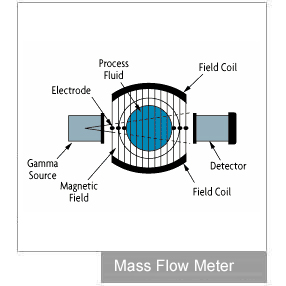
Before specifying a flow meter, it is also advisable to determine whether the flow information will be more useful if presented in mass or volumetric units. When measuring the flow of compressible materials, volumetric flow is not very meaningful unless density (and sometimes also viscosity) is constant. When the velocity (volumetric flow) of incompressible liquids is measured, the presence of suspended bubbles will cause error; therefore, air and gas must be removed before the fluid reaches the meter. In other velocity sensors, pipe liners can cause problems (ultrasonic), or the meter may stop functioning if the Reynolds number is too low (in vortex shedding meters, RD > 20,000 is required).In view of these considerations, mass flow meters, which are insensitive to density, pressure and viscosity variations and are not affected by changes in the Reynolds number, should be kept in mind. Also underutilized in the chemical industry are the various flumes that can measure flow in partially full pipes and can pass large floating or settleable solids.
Choose the right Flow Meter
Rotameters or Variable Area Flow Meter The rotameter is a tapered tube and a float. It is the most widely used for for gases and liquids flow measurement because of its low cost, simplicity, low pressure drop, relatively wide rangeability, and linear output.
Spring and Piston Flow Meters Piston-type flow meters use an annular orifice formed by a piston and a tapered cone. The piston is held in place at the base of the cone (in the "no flow position") by a calibrated spring. Scales are based on specific gravities of 0.84 for oil meters, and 1.0 for water meters. Their simplicity of design and the ease with which they can be equipped to transmit electrical signals has made them an economical alternative to rotameters for flowrate indication and control.
Mass Gas Flow MetersThermal-type mass flow meters operate with minor dependence on density, pressure, and fluid viscosity. This style of flow meter utilizes either a differential pressure transducer and temperature sensor or a heated sensing element and thermodynamic heat conduction principles to determine the true mass flow rate. Many of these mass flow meters have integral displays and analog outputs for data logging. Popular applications include leak testing and low flow measurements in the milliliters per minute.
Ultrasonic Flow MetersThe ultrasonic doppler flow meters are commonly used in dirty applications such as wastewater and other dirty fluids and slurries which ordinarily cause damage to conventional sensors. The basic principle of operation employs the frequency shift (Doppler Effect) of an ultrasonic signal when it is reflected by suspended particles or gas bubbles (discontinuities) in motion.
Turbine Flow MetersThe turbine meter can have an accuracy of 0.5% of the reading. It is a very accurate meter and can be used for clean liquids and viscous liquids up to 100 centistokes. A minimum of 10 pipe diameters of straight pipe on the inlet is required. The most common outputs are a sine wave or squarewave frequency but signal conditioners can be mounted on top for analog outputs and explosion proof classifications. The meters consists of a multi-bladed rotor mounted at right angles to the flow and suspended in the fluid stream on a free-running bearing.
Paddlewheel SensorsOne of the most popular cost effective flow meters for water or water like fluids. Many are offered with flow flittings or insertions styles. These meters like the turbine meter require a minimum of 10 pipe diameters of straight pipe on the inlet and 5 on the outlet. Chemical compatibility should be verified when not using water. Sine wave and Squarewave pulse outputs are typical but transmitters are available for integral or panel mounting. The rotor of the paddlewheel sensor is perpendicular to the flow and contact only a limited cross section of the flow.
Positive Displacement Flow MetersThese meters are used for water applications when no straight pipe is available and turbine meters and paddlewheel sensor would see too much turbulence. The positive displacement are also used for viscous liquids.
Vortex MetersThe main advantages of vortex meters are their low sensitivity to variations in process conditions and low wear relative to orifices or turbine meters. Also, initial and maintenance costs are low. For these reasons, they have been gaining wider acceptance among users. Vortex meters do require sizing, contact our flow engineering.
Pitot Tubes or Differential Pressure Sensor for Liquids and GasesThe pitot tubes offer the following advantages easy, low-cost installation, much lower permanent pressure loss, low maintenance and good resistance to wear. The pitot tubes do require sizing, contact our flow engineering.
Magnetic Flow meters for Conductive LiquidsAvailable in in-line or insertion style. The magnetic flow meters do not have any moving parts and are ideal for wastewater application or any dirty liquid which is conductive. Displays are integral or an analog output can be used for remote monitoring or data logging.
Anemometers for Air Flow MeasurementHot wire anemometers are probes with no moving parts. Airflow can be measured in pipes and ducts with a hand held or permanent mount style. Vane anemometers are also available. Vane anemometers are usually larger than a hot wire but are more rugged and economical. Models are available with temperature and humidity measurement.
Sunday, July 22, 2018
Level measurement systems
LEVEL MEASUREMENT SYSTEMS
- Float methods
- Buoyancy method
- Vibrating level systems
- Differential pressure level detectors
- Bubbler systems
- Conductivity probes
- Capacitance probes
- Optical level switches
- Ultrasonic level detectors
- Microwave level systems
- Nuclear level systems
Floats
Design of floats
Buoyancy method
Vibrating level switches
Hydrostatic pressure methods
Bubbler systems
Conductivity level probes
- For electrically conductive liquid
- For nonconductive liquids
Applications
Optical level switches
Ultrasonic level measurement
Ultrasonic level-meter with compensation
Microwave level systems
Radar level gauge
Nuclear level systems
Some guidelines for selecting instruments
to be used for the indication or control of level
Process instrumentation.
- A sensor, which is sometimes called a primary measuring element, to measure required physical properties
- A transducer, which converts the sensor signal into a standard signal form that suits the control system such as a pneumatic signal (3-15 psi), an electric signal (4-20 mA), a digital signal of Foundation Fieldbus, etc.
- A transmitter, which prepares the transducer signal for transmission without loss and then transmits it. Smart transmitters also send meaningful data about the status of the measuring instrument as a whole.